
Cloud

Cloud transformation for broadcasters and media companies, including orchestration and automation of media workflows in the cloud, for agile, cost-efficient, and future-proof hybrid cloud models in scalable broadcast production environments.
Unleash the power of digital transformation
Digital transformation is no longer an option; it is a necessity. While many companies recognize the cloud as a key enabler, they often lack a clear strategy for effective implementation. A well-defined cloud strategy is the key to greater agility, reduced costs, and sustainable growth. Recent studies show that companies with a clearly defined cloud strategy can reduce operating costs by up to 30 percent while significantly increasing their market agility (Gartner, 2024).
Qvest supports companies on this journey – from initial strategy development to migration and secure, optimized cloud operations. This is not just about technological implementation but a holistic transformation that enhances efficiency, drives innovation, and strengthens competitive advantages.
Strategic success factors of the cloud
- Optimized resource utilization: Maximum efficiency through demand-driven scalability
- Enhanced collaboration: Seamless workflows across distributed teams
- Superior user and customer experiences: Optimized digital interactions and faster response times
- Adaptability in dynamic markets: The flexibility to embrace future developments
The cloud is more than a technology — it is a catalyst for sustainable innovation. Qvest ensures businesses navigate this transition strategically, securely, and with maximum value.
Our key services
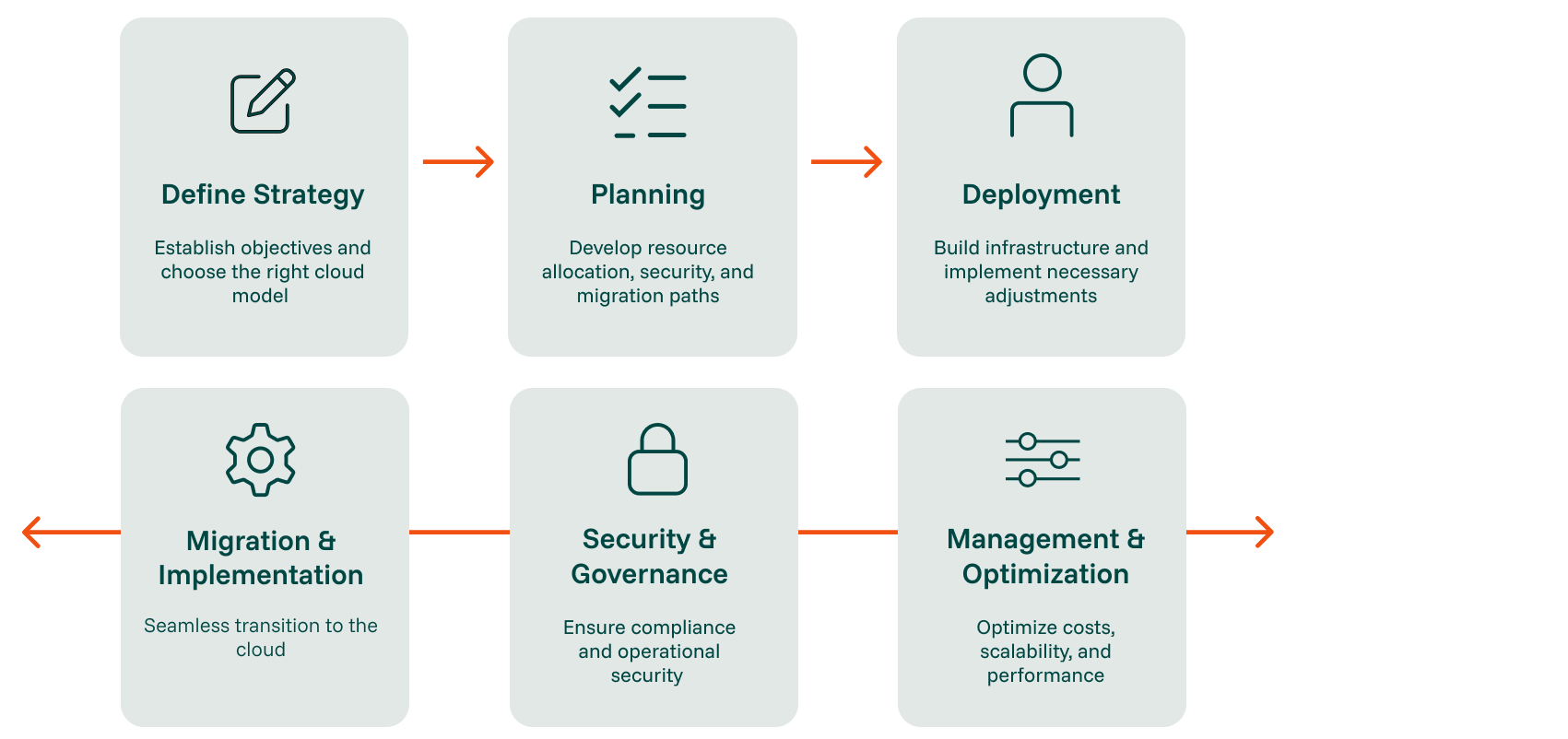
Cloud Consulting, Strategy, and Roadmapping
Every successful cloud transformation starts with a clear strategy. Qvest assesses existing IT landscapes, defines optimal cloud models (public, private, hybrid), and develops a tailored roadmap for a smooth transition.
Cloud Migration and Implementation
Moving to the cloud requires technical expertise and precise planning. Qvest minimizes business disruptions through efficient migration strategies (lift-and-shift, re-platforming, refactoring) and ensures applications and data are fully optimized in the cloud.
Cloud Security and Compliance
Security and data protection are top priorities in cloud transformation. Qvest safeguards cloud environments with security assessments, identity and access management (IAM), data encryption, and compliance monitoring, tailored to industry-specific regulations.
Cloud Optimization and Cost Management
Optimization is an ongoing process beyond migration. Qvest maximizes ROI and cost transparency through automated monitoring, dynamic resource allocation, and intelligent scaling strategies.


Qvest Cloud: agile, efficient, future-proof
Our core solutions — spanning orchestration, automation, monitoring, and performance analysis — enable a future-ready, flexible, and cost-effective cloud operation.
- Public, private, and hybrid cloud models for maximum adaptability
- Centralized control and real-time monitoring for optimal resource management
- Seamless integration with third-party ecosystems for enhanced functionality
Unlock your full operational potential with Qspaces

Qspaces
Optimize your operations with Qspaces – the flexible Solution-as-a-Service platform that accelerates technological transformation, optimizes costs, and promotes sustainability.
What sets us apart – your benefits
Our cloud specialists combine technical excellence with deep industry knowledge to develop solutions that remain relevant long into the future.
Qvest bridges the gap between on-premises and cloud technologies, ensuring seamless integration across multiple providers and systems.
From media & entertainment to industrial, consumer goods, and public sectors, we provide tailored cloud strategies to meet specific business needs.
Cloud transformation demands close collaboration. We support companies at every step — from initial strategy to long-term optimization.


