
Dynamic Media Facility: Qvest Publishes Guide to Software-Defined Media Production
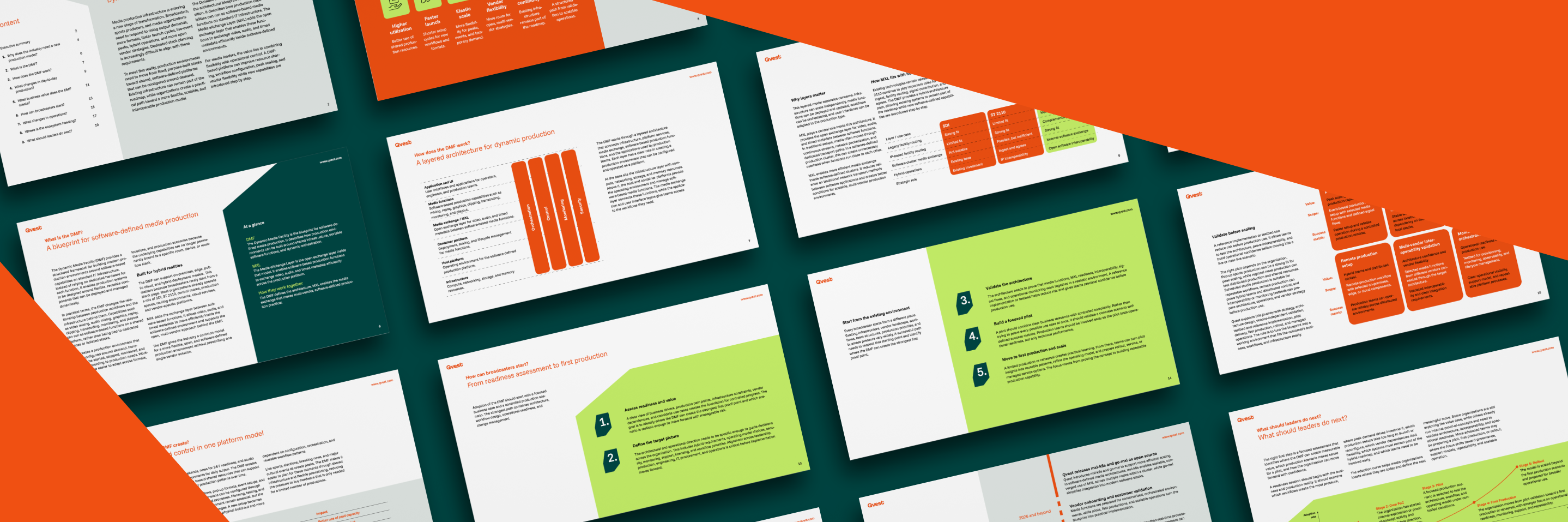
Cologne, July 9, 2026 – More content, new formats, and shorter production cycles are placing increasing pressure on media organizations. At the same time, traditional hardware-based production models are reaching their limits. In response to these industry developments, Qvest, a global leader in media-focused services, has published “The DMF Adoption Guide.”
A key focus of the guide is the Dynamic Media Facility (DMF), an architectural model for software-defined media production developed and defined by the European Broadcasting Union (EBU). DMF provides a framework for transforming traditional, fixed production environments into flexible, software-defined platforms. DMF builds on the Media eXchange Layer (MXL), an EBU-led open-source industry initiative that enables vendor-neutral exchange of video, audio, and metadata between software-based media applications. The result is a new operating model that is rapidly becoming essential for meeting future production requirements.
At the same time, many media organizations face the challenge of finding the right starting point for building software-defined production platforms in order not only to keep pace with industry developments, but to actively shape the future of software-defined media production.
“The introduction of new production environments has traditionally been an infrastructure project with lead times measured in months,” says Daniel Clasen, co-author of the DMF Adoption Guide and Practice Lead Custom Software Solutions at Qvest. “With software-defined platforms, it becomes a simple configuration task. Setups and workflows can now be deployed, adapted, and scaled flexibly. This can be done within hours and, ultimately, even minutes.”
For many media organizations, faster deployment and scaling of production environments is becoming a key factor in balancing growing production demands with budget constraints, operational complexity, and vendor dependencies.
“The real value of DMF lies in using existing resources more efficiently,” says Patrick Steinert, co-author of the guide and Head of Technology Consulting at Qvest. “Instead of dedicating capacity to individual applications, DMF enables much more flexible utilization across a wide range of production scenarios, creating the foundation for scalable and economically sustainable production models. The most important development is that DMF and MXL are now moving from a theoretical reference architecture into practical deployment. The next phase will be shaped by open standards, multi-vendor interoperability, and real-world customer implementations.”
The guide outlines how organizations can get started and gradually bring DMF and MXL into operational environments. It also explores what this transition means for production processes, time-to-market, and infrastructure strategies, and how media companies can successfully turn these concepts into operational reality.
Download “The DMF Adoption Guide” here.