Qvest Demonstrates Industry’s Largest Multi-vendor Dynamic Media Facility (DMF) Showcase at IBC 2026
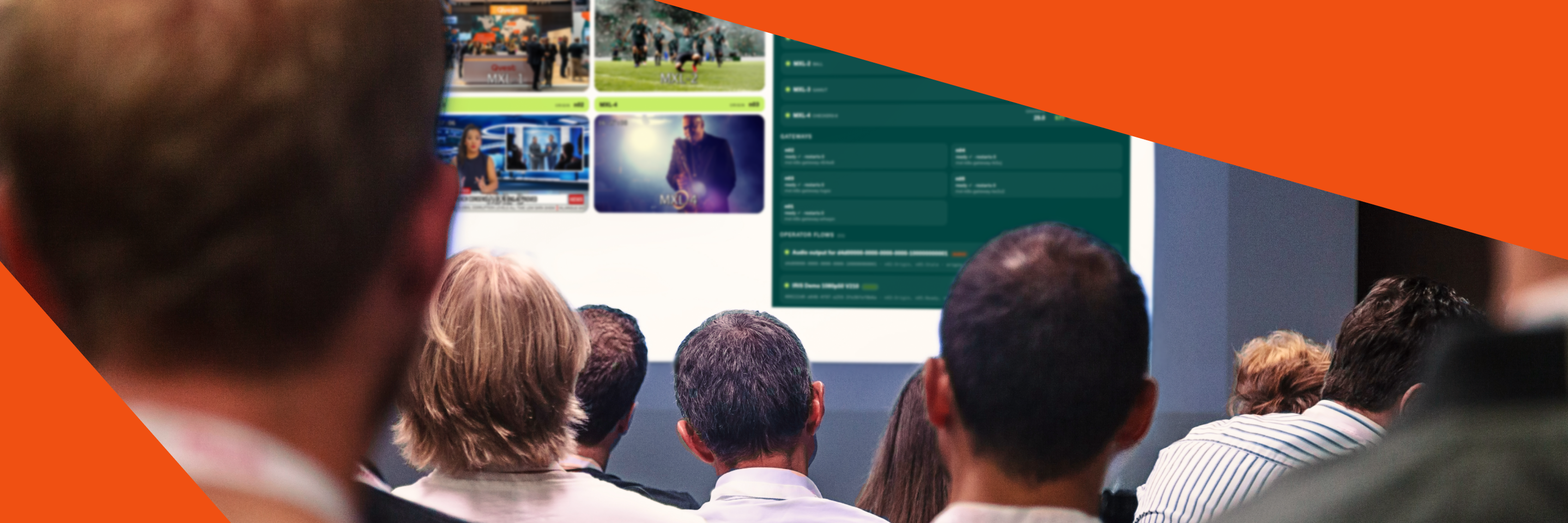
Cologne, September 01, 2026 – Qvest, a global leader in media-focused services, together with partners, will present the most interconnected multi-vendor Dynamic Media Facility (DMF) Showcase at IBC 2026. Developed together with leading industry partners, the showcase demonstrates how the European Broadcasting Union's (EBU) Dynamic Media Facility architecture can be implemented in practice through an open, interoperable software-defined production environment.
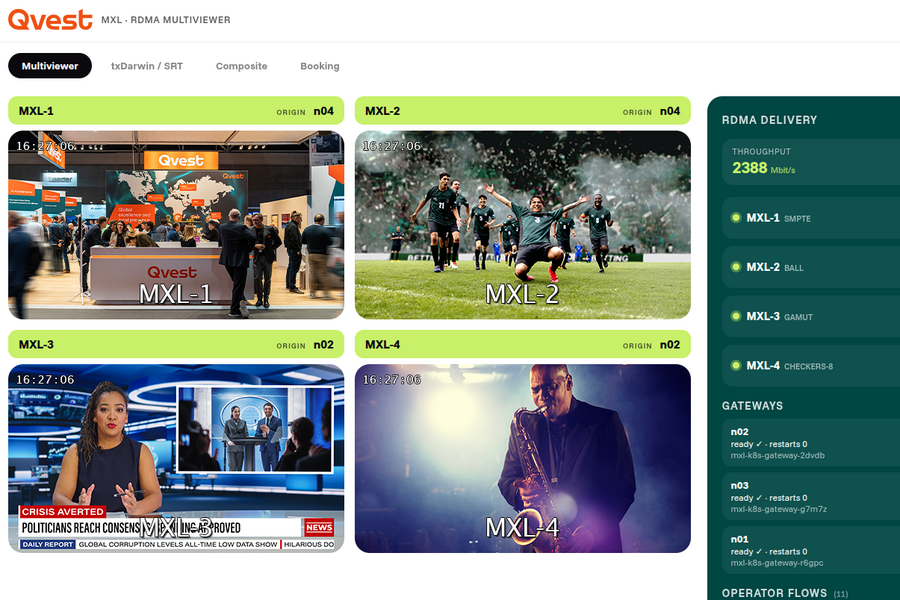
Qvest’s Dynamic Media Facility (DMF) Showcase provides a tangible reference implementation that brings together orchestration, media processing, audio, monitoring, and lifecycle management capabilities from multiple vendors within a shared fully operational environment. Running on commodity infrastructure as well as in cloud environments, the showcase demonstrates how software-defined production workflows can be deployed across different infrastructure models without vendor lock-in.
“Broadcasters are increasingly looking beyond architectural concepts and asking what already works in practice,” said Daniel Clasen, Practice Lead Custom Software Solutions at Qvest. “With the DMF Showcase, we are demonstrating how open, software-defined production can be implemented today. Together with our partners, we are turning the Dynamic Media Facility from a reference architecture into a practical reference implementation and providing a blueprint for the future of media production.”
“One of the biggest opportunities in software-defined production is to use resources more efficiently,” said Patrick Steinert, Head of Technology Consulting at Qvest. “Production environments are often underutilized because infrastructure is dedicated to individual workflows. Our DMF Showcase demonstrates how shared, software-defined resources can be used more efficiently across a variety of production scenarios and provide a practical path toward more flexible and efficient operations. It also reflects an important milestone: we have created a functional DMF implementation, which will soon be deployed in customer environments.”
The showcase brings together a growing ecosystem of technology partners, each contributing a specific capability to the reference implementation.
Intel provides two Intel(r) Xeon(r) Processor based servers equipped with E800 series Network Interface Cards, with support for ST2110 and RDMA, as the compute foundation for the DMF Showcase, supporting the execution and dynamic orchestration of software-defined media workloads.
Matrox Video contributes Matrox ORIGIN, an asynchronous media framework designed for the rapid development of software-defined live media facilities. It offers a wide range of media processing capabilities, a Kubernetes-native operator for scheduling media tasks, and an exceptional developer experience to DMF deployments.
NETGEAR provides the network foundation with its M4350-40X4C, a 40-port 10G switch with 100G uplinks that carries uncompressed ST 2110 flows alongside control, orchestration, and management traffic on a single fabric.
Ross Video contributes an SRT-to-MXL media function, enabling SRT-based contribution feeds to be integrated into the MXL-based DMF environment.
Riedel is showcasing some the latest developments around DMF architecture utilizing containers and MXL replication to enrich current workflows and to enable multi-node media processing.
Skyline Communications provides event planning and automated orchestration through its DataMiner xOps platform, coordinating operational and technical resources and managing the lifecycle of dynamic media functions across the environment.
TAG Video Systems powers the monitoring layer with TAG Core, its 100% software multiviewing and QC platform, giving operators continuous visibility across MXL, ST 2110, compressed and OTT signals.
Telos Alliance’s Minnetonka Audio UPMAX unlocks immersive 5.1/7.1.4 audio, Minnetonka Audio ARC guarantees the best quality in compliant loudness, and together they deploy effortlessly as containerized media functions within DMF.
Techex contributes tx darwin, a native software processing platform offering native MXL-powered features such as standards conversion, switching and compression with powerful monitoring and a DMF aligned architecture focused on integration and configurable media functions.
Telestream contributes its Pulse platform, enabling MXL-based ST 2110 media flows to be integrated into the DMF environment while providing monitoring with waveform and vector scopes across the workflow.
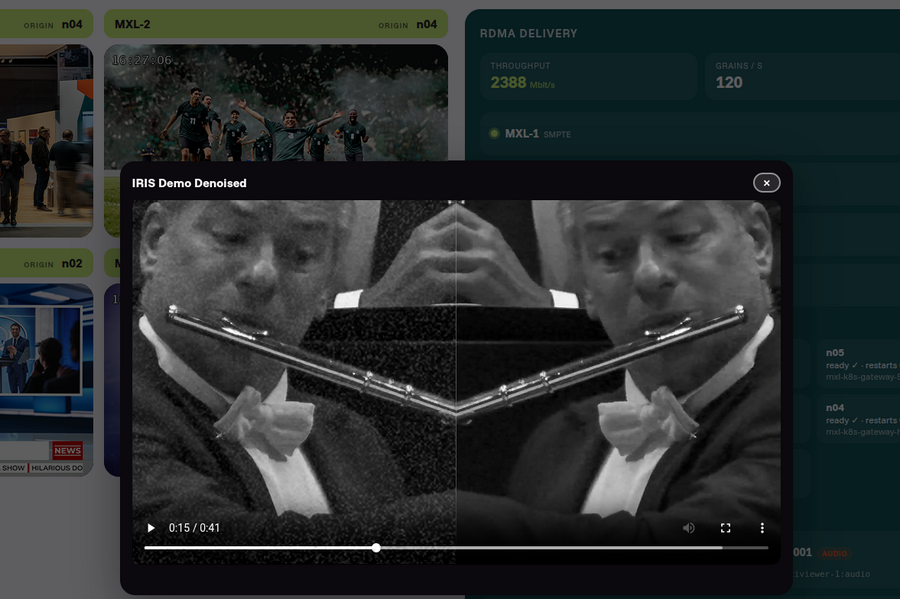
Wavelet Beam showcases IRIS-VIDEO Denoising alongside its MXL Apps (Player, Recorder, 10 Bit Viewer). This GPU-accelerated live tool removes sensor noise and compression artifacts before encoding, reducing video bandwidth and costs while boosting compression efficiency and maintaining image quality.
The EBU’s Dynamic Media Facility architecture is designed to enable open, software-defined production based on shared resources and vendor-neutral interoperability. Through active participation in the AMWA-EBU JT-DMF Task Force and code contributions to the Linux Foundation MXL Project, Qvest continues to support the advancement of open standards and interoperable software-defined media architectures.
The Dynamic Media Facility Showcase serves not only as a demonstration environment, but also as a practical platform for validating interoperability, identifying integration challenges, and accelerating adoption of DMF across the MediaTech industry.
IBC visitors are invited to experience the Dynamic Media Facility Showcase and its open, multi-vendor production environment at the Qvest booth 10.C24 during IBC 2026 in Amsterdam.