Beyond the peak-capacity plant: The business case for the Dynamic Media Facility
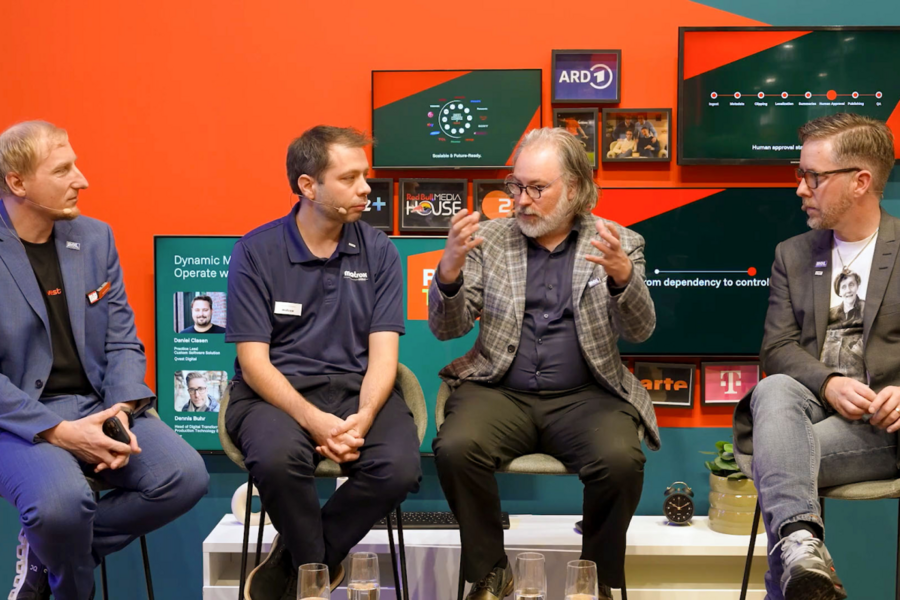
At NAB Show NY, Qvest was joined by industry leaders on a panel to discuss how Dynamic Media Facilities (DMF) are replacing static, peak-capacity broadcast engineering with agile, software-defined workflows.
Ben Kepler, Senior Manager - Broadcast IT Technologist at Qvest | Mike Strein, Principal at Strein et al, LLC & Retired-ABC News |
Thomas Edwards, Senior Manager, Solutions Architecture at AWS | Naveed Aslam, Senior Vice President, Production Technology & Engineering at Skydance
Rethinking the broadcast plant
Broadcast facilities have spent decades over-buying hardware just to survive their busiest days. The result is millions of dollars in hardware sitting idle between live events. With flat budgets and audiences scattered across digital platforms, paying for racks of single-purpose gear is no longer viable. The Dynamic Media Facility (DMF), backed by the European Broadcasting Union (EBU) and continues through the JT-DMF AMWA effort, breaks the cycle by swapping heavy hardware for nimble microservices that run only when you need them.
| Business priority | DMF solution | Impact |
|---|---|---|
| Improve utilization | Shared resource pool | Better use of paid capacity |
| Launch faster | Software-based configuration | Shorter time to market |
| Scale peaks | Elastic infrastructure | Less pressure to buy for rare peaks |
| Protect flexibility | Open MXL-based exchange | More vendor choice |
| Reduce transition risk | Hybrid roadmap | Modernization through a phased transition |
| Strengthen operations | Platform orchestration | More control and repeatability |
Protecting and extending current investments
Adopting DMF protects your SMPTE ST 2110 investments rather than replacing them. Instead of locking IP streams into dedicated boxes, DMF adds an agile software layer, allowing you to turn on, turn off, or send to the cloud whenever a production demands extra resources.
 2110 is an important next evolution for media facilities, but DMF truly unlocks the potential of what you can do across an IP fabric. The idea of sharing and being able to reprioritize tasks many times over during the course of a day – that for us will really be the mark of success.

Naveed Aslam, Senior Vice President, Production Technology & Engineering, Skydance
Financial predictability and Dynamic Software Licensing
Flexible technology demands flexible pricing. Paying full-time software fees for tools that only run during short live events is a waste. Through initiatives like Dynamic Software Licensing (DSL), control systems can automatically check licenses in and out via APIs for specific shows, rehearsals, or failovers, returning them to the pool the moment production wraps. This shifts untracked enterprise overhead into accurate, show-level cost accounting.
With software-based virtualized production, you should be able to highly accurately predict your costs ahead of time... Ahead of time, you should be able to know and perhaps bill to that cost center exactly what's going to be required for that event. Thomas Edwards, Senior Manager, Solutions Architecture, AWS
From bottlenecks to builders
The real value of a Dynamic Media Facility lies in how it changes the way your teams work.
When the underlying complexity of container orchestration, network fabrics, and cloud environments is abstracted away, production staff and technical directors experience a frictionless, reliable workflow:
- Rapid prototyping: Build, test, and tear down experimental production setups in hours instead of months.
- True multi-purpose spaces: Turn one control room into a morning news hub, a daytime editing suite, and an evening sports deck with software presets.
- Zero operational disruption: Talent and technical directors keep their familiar physical control surfaces while computing shifts invisibly across local servers and the cloud.
The path forward
Over-provisioning hardware is a drain on capital. By adding software microservices and dynamic licensing to your existing ST 2110 backbone, you get maximum plant utilization at a fraction of the operating cost.
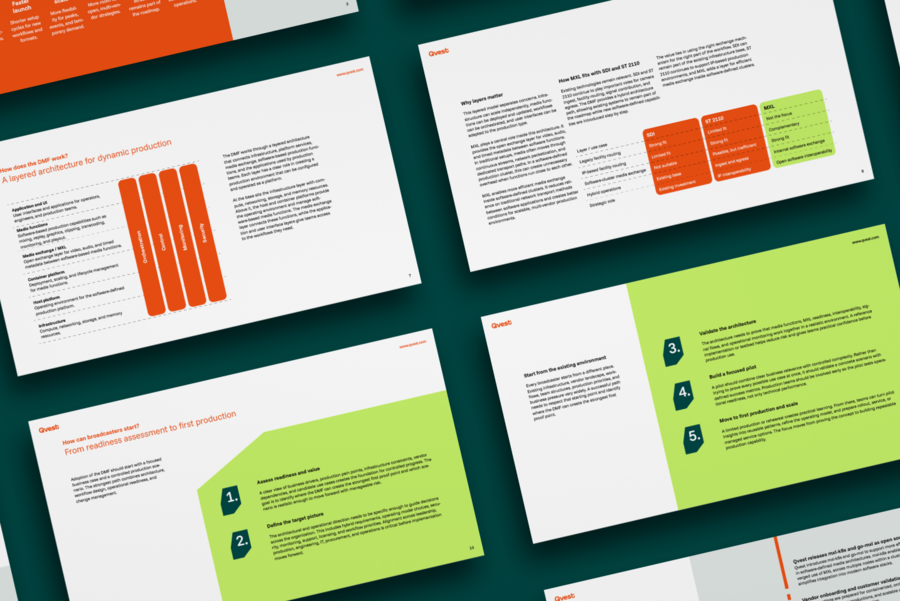
Download Qvest’s DMF Adoption Guide to learn how to transition your facility from static hardware to an agile, dynamic media environment.