
Moments matter: Unlocking the value of live sports in real time
At NAB Show NY, Qvest was joined by NVIDIA on a panel to discuss transforming key live sports moments to real-time monetization capabilities.
Avery Pfeiffer: AVP - Applied AI & R&D, Qvest | Glen Herold: AVP, Head of Sports, Qvest | Michael Kaplan:
Director, AI for Media Ecosystem & Partner GTM, NVIDIA
The attention decay problem
Live sports operate on an unforgiving timeline: a jaw-dropping touchdown or sudden turnover commands an intense but rapidly expiring window of fan attention. Traditional broadcast pipelines rely on manual tagging, clipping, reframing, and graphic compositing, typically delivering highlights 15 to 45 minutes after the play.
By that point, the viral conversation on TikTok and Instagram has moved on, low-production mobile captures have saturated social feeds, and premium sponsorship value is lost. Media organizations do not lack content volume; they lack the real-time operational velocity to monetize peak fan emotion.
Tools that adapt to your current set-up
Capitalizing on live moments requires software that understands sports action as it happens.
Instead of using complex custom AI models, the pipeline pairs foundation models (such as Claude) as well as first-party open source models (such as NVIDIA’s Cosmos 3) with the NVIDIA Sports Intelligence Playbook. This framework embeds sport-specific rules, camera geometries, and broadcast semantics directly into live ingestion. Running on-premise compute engines like the NVIDIA Spark or the NVIDIA Holoscan Platform for Media, the system processes live SRT and HLS feeds faster than real time, identifying pivotal moments, audio spikes, and tactical shifts at sub-second intervals.
NVIDIA’s Cosmos 3 model was originally designed to generate synthetic training data for autonomous vehicles. The team repurposed it for live sports because of its strong capability to parse and understand physical environments.
Real-time video reframing as fast as the play
Modern audiences consume sports through mobile-first, vertical 9:16 video centered around individual athlete storylines rather than traditional 16:9 widescreen feeds.
 Think about when the moment matters: most people are going to be on the mobile phone. If there is technology that lets a human access more data, do more edit decisions, and put together more packages for various outlets of distribution, that’s the key. There’s monetization with [that] technology.

Michael Kaplan: Director, AI for Media Ecosystem & Partner GTM, NVIDIA
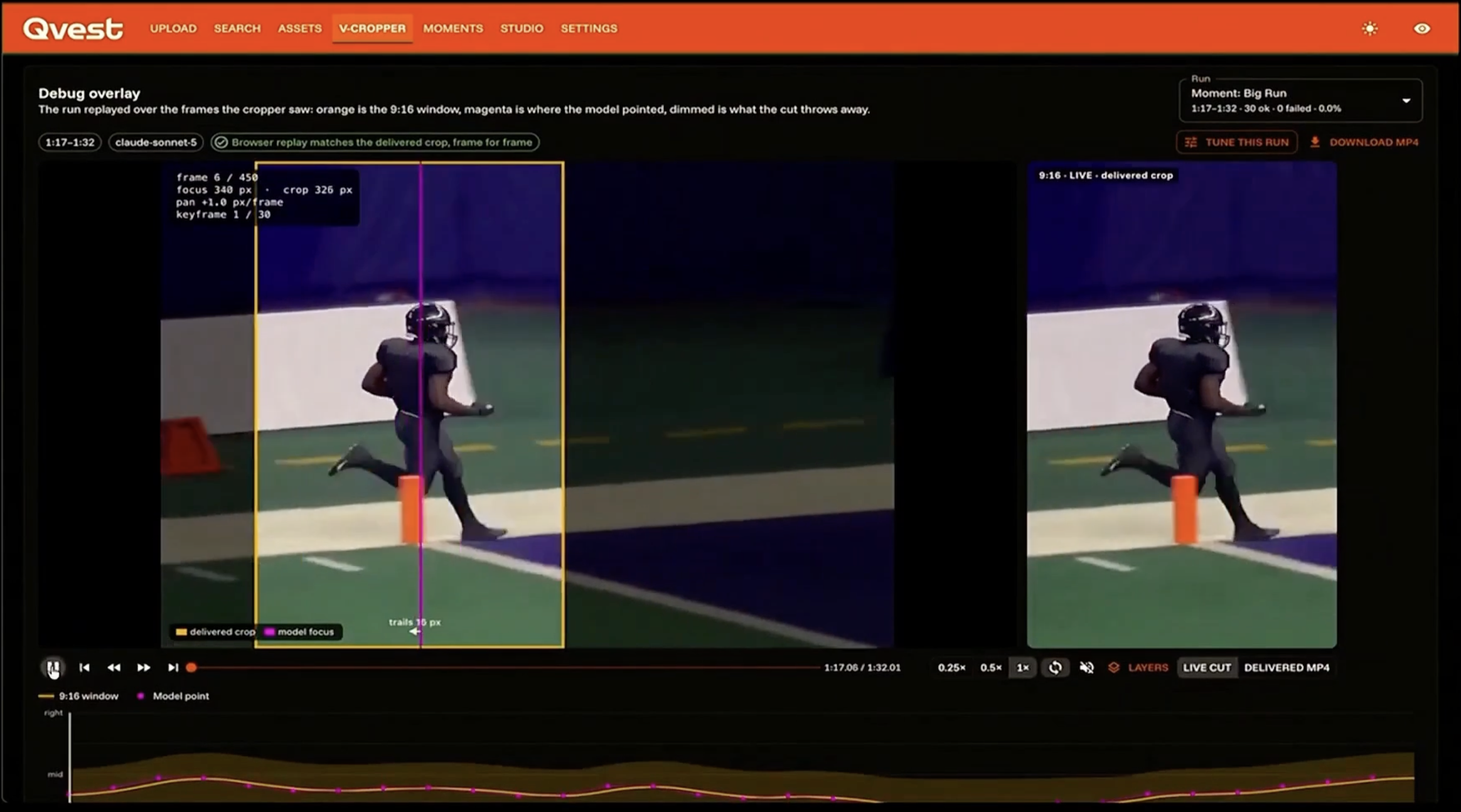
Qvest’s open-source V-Cropper bridges this divide. Rather than applying center-punched crops flanked by black bars, the tool dynamically predicts points of interest (POI), such as a ball carrier or referee signal, maintaining enough visual space around a player as they sprint down the field or track so the viewer can still see what is happening around them. Simultaneously, real-time segmentation models (like Meta’s SAM) isolate players from complex background geometry, enabling dynamic motion trails and targeted visual enhancements without manual rotoscoping. Finally the accelerator includes Virtual Scoreboard Reconstruction functionality, intelligently reading and recreating the broadcast scoreboard, for the new 9:16 vertical frame.
Expanding business values into media ad sales
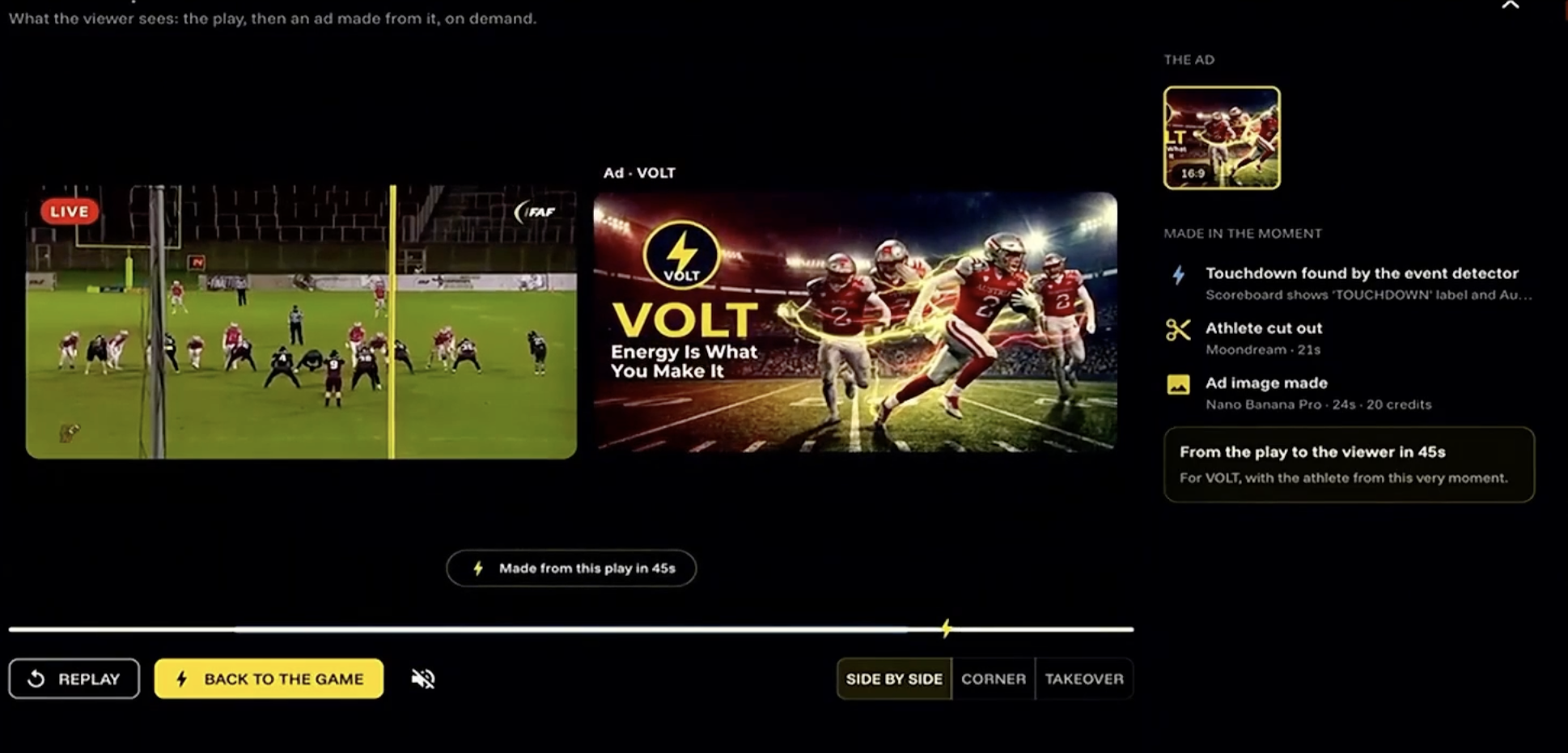
Unlocking net-new commercial inventory while action remains live on the field opens new engagement channels, allowing advertisers to reach buyers faster. Instead of generic sponsor slates, broadcasters can execute Just-in-Time Ad Activations within 45 seconds of a play occurring. For example, when a big play happens, the system clips the player, adds a sponsor’s logo and copy, and shows the add onscreen, as well as publishing a vertical version of the ad to social feeds within seconds.
Crucially, automation empowers rather than replaces human editors. The system’s Producer View operates as an agentic command center, searching catalogs, sequencing story beats, and pre-assembling clips into curated stacks ready for one-click review, revision, or export into tools like Adobe Premiere.
You don't ever want to take the human out of it. Instead, you want to use these AI agents for what they're good at, which is producing. The key is you're empowering your producers to not have to manually string clips together, but instead come to work and have a stack of produced content that they can review, edit, approve, and send down the line. Avery Pfeiffer: AVP - Applied AI + R&D, Qvest
What next?
The union of NVIDIA’s accelerated computing frameworks and Qvest’s workflow orchestration redefines the economics of live sports production.
Delivered as an open, customer-owned accelerator codebase rather than a restrictive SaaS lock-in, the framework applies equally to live feeds and petabyte-scale archival retrieval. Broadcasters that operationalize real-time intelligence will capture the viral moment, engage fractured audiences, and transform fleeting highlights into durable enterprise revenue.


